Please read and comply with local laws and regulations before each flight.
** All data was tested using a DJI FlyCart 30 product model in a controlled environment. Actual performance may vary depending on the environment, usage, and firmware version.
*** All videos and photos on this page were captured in strict compliance with applicable local laws and regulations.
**** Please activate the DJI FlyCart 30 using the DJI Pilot 2 app before use.
Measurements taken at sea level. Please pay attention to the differences between single-battery and dual-battery configurations. The maximum loaded weight must not exceed the recommended value. Avoid placing sharp objects inside the cargo boxes. When using the winch system, ensure that packages do not collide with the landing gear. Otherwise, flight safety may be compromised.
Measurements taken with the DJI FlyCart 30 operating on dual batteries, flying at a constant speed of 15 m/s in a windless environment at sea level, without a payload, until the displayed battery level reached 0%. Data is for reference only. Please pay attention to Return-to-Home (RTH) prompts in the DJI Pilot 2 app during flight.
Measurements taken with the DJI FlyCart 30 operating on dual batteries, flying at a constant speed of 15 m/s in a windless environment at sea level, carrying the maximum payload, until the displayed battery level reached 0%. Data is for reference only. Please pay attention to Return-to-Home (RTH) prompts in the DJI Pilot 2 app during flight.
Measurements taken with the DJI FlyCart 30 operating on dual batteries and carrying the maximum payload in a windless environment at sea level. Data is for reference only.
The DJI FlyCart 30’s payload capacity decreases as takeoff altitude increases. An altitude of 6,000 m is the maximum safe operating altitude for the DJI FlyCart 30 flying in dual-battery mode without a payload, when taking off at an altitude of 4,500 m. An altitude of 3,000 m is the maximum safe operating altitude for the DJI FlyCart 30 carrying the maximum payload.
Measurements taken with an estimated solar irradiance of 960 W/m². Prolonged exposure to high temperatures may reduce the service life of certain components.
During takeoff and landing, the DJI FlyCart 30 can withstand wind speeds of up to 12 m/s.
Measurements taken in an unobstructed environment with low interference. Data is for reference only. Please pay attention to in-app reminders during flight.
A second remote controller is sold separately.
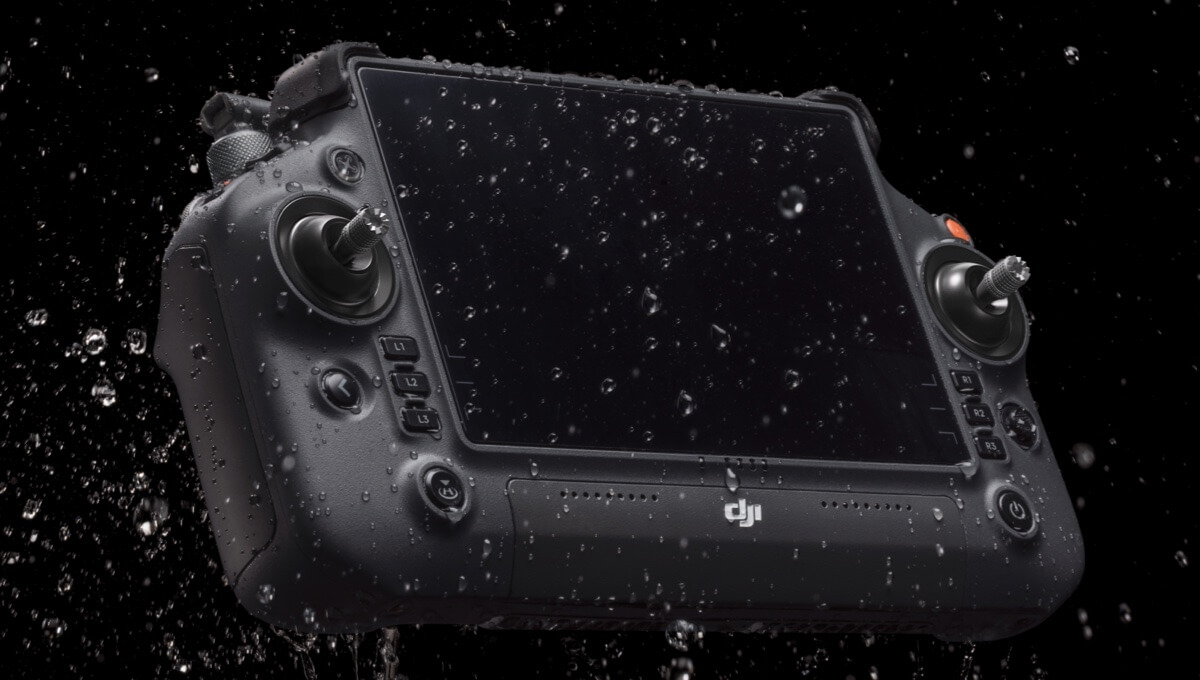
The protection rating is not permanent and may gradually decrease over time due to normal wear and tear. The protection rating does not apply to the propulsion system. After flying in the rain, it is recommended to let the propulsion system run at idle on the ground for one minute to prevent corrosion or rust (precipitation exceeding 24.9 mm within 24 hours).
The effective detection range and obstacle detection capabilities may vary depending on ambient lighting, rain, fog, and the material, position, shape, and other properties of obstacles. Downward obstacle detection is primarily used to help measure ground clearance. Detection in other directions is used for obstacle detection.
The internal dimensions of the expanded polypropylene (EPP) cargo box are 573 × 416 × 306 mm (L × W × H).
When the DJI FlyCart 30 operates on dual batteries and flies with the maximum payload in a windless environment at 25°C and sea level, the minimum altitude for parachute deployment is 60 m, and the terminal descent speed is 6 m/s.
Measurements taken in a laboratory at 25°C, in a windless environment at sea level.
Center-of-gravity and weight detection are not continuously valid. Perform a tare calibration when necessary.
The 2.5D base map is a 2D map overlaid with elevation data.
The battery is covered by a warranty of 1,500 cycles or 12 months, whichever comes first.
When fast-charging a single battery, ensure that the charger uses two 220 V cables simultaneously and that the power supply line and outlet can support the charging power.
The charger’s theoretical maximum power. Actual power may vary depending on the voltage.
Sold separately.


 DJI Delivery